Getting to Know Your Sustainable Staff, Continued

Introducing:  Mariah Fuller, our social media intern!

1.) What is your role in GCSU’s sustainability efforts, and what brought you to it?

Currently my efforts are not only being sustainable myself, but helping others become sustainable. What I can do individually for the environment doubles just by reaching out to a friend and getting them involved as well. I came across the Sustainability Council kind of by accident while searching for a job, and now I get to be involved with helping the campus become more sustainable.
13346656_1048335845260513_3596228142773721906_n

2.) What does being sustainable mean to you? How do you incorporate this into your everyday life?

To me, being sustainable is trying to help our world not just now or in the next year, but decades from now. Being sustainable means doing your part and inspiring others to make this world a better place to live. Fortunately for me being a part of Sustainability Council makes it easier for me to be involved daily, and I’m able to use our social media platforms to help spread the message across campus about becoming more sustainable.

3.) What changes do you hope to see in sustainability efforts made on campus?

Hopefully in the near future we will see sustainability be something that you don’t even have to think about, you just do. I would love to see the sustainability efforts on campus be something that comes as naturally to us as brushing our teeth.

4.) If you could single-handedly correct any environmental issue in the world, which would you choose?

If I could correct any environmental issue in the world I would choose climate change. President Barack Obama recently said in a New York Times interview, “Translating concern into action is the challenge. Part of what makes climate change difficult is that it is not an instantaneous catastrophic event, it’s a slow-moving issue that, on a day-to-day basis, people don’t experience and don’t see.”

Getting to Know Your Sustainable Staff

Because our sustainable efforts wouldn’t be possible without the all of the wonderful people on our team, we’d like to introduce individual staff members to the campus through this blog. We thought this questionnaire would be the perfect opportunity to showcase the identities and causes of the figures behind our efforts. So, without further ado, prepare to meet our wonderful staff!

Introducing: Cam Skinner!

12189775_1029932973703877_7093397564620517396_n1.) What is your role in Georgia College’s sustainability efforts, and what brought you to it? 
I actively work with the Sustainability Office by volunteering at particular campus events that raise awareness towards sustainable practices. I originally joined the office when I began drafting a proposal that would need the council’s review

2.) What does being sustainable mean to you? How do you incorporate this into your everyday life?

Being an environmental science major, being sustainable to me means to keep the needs of future generations in consideration at all times. In other words, ensuring that the current population doesn’t overuse their resources. I attempt to incorporate sustainable practices into my everyday life such as utilizing CFL light bulbs, walking to class instead of driving or taking a bus, and recycling when possible. I think it is also important to spread the definition of what being sustainable actually is, and this is why I participate in the events hosted by the Sustainability Office here on campus.

     3.)   What changes do you hope to see in the sustainability efforts on campus?

I want to see a decreased amount of food waste on campus. With the projects of the composter and, hopefully, the initiation of a Campus Kitchen I hope to see that the amount of food that is wasted becomes minimized.

     4.)   If you could single-handedly correct any environmental issue in the world, which would you choose?

It would definitely have to be the most recognized environmental issue of climate change. Unfortunately, this is a problem that has become almost irreversible due to human impacts.


Saving the Planet, One Cardboard Box at a Time

In an effort to further GCSU’s sustainability awareness and effectiveness, nine different recycling stations were set up in convenient locations on the one day of the year when Georgia College’s waste output is significantly upped: move in day. In the sweltering heat, roughly 18 selfless, charitable volunteers manned the stations and spent the day flattening cardboard boxes and slowly but surely bettering the planet’s welfare. Volunteers cheerily intercepted numerous students and their parents as they headed for the dumpsters, and, at the end of the day, took the numerous containers to the train depot to be deposited to the center campus recycling center.

However, these noble efforts were not devoid of inconveniences. Based on a report written by Mary Plauche, many students were unaware of which items were recyclable. Another difficult aspect of the day was the sheer heat which the volunteers and to endure. Mary also reported that while snacks were abundant, water supply was of constant importance.

In comparison to numerous other colleges, GCSU’s move-in day recycling program is actually quite unique. Upon researching universities such as UGA, Georgia Southern, and University of North Georgia, Georgia College was the only one with such a structured and involved program. However, Texas Tech’s program closely rivals ours. After interviewing a representative of Tech’s sustainable housing resource, it was evident that although our recycling methods are roughly the same (majority cardboard materials, stations set up around campus), they incorporated student involvement in ways that GCSU hasn’t.

“We participate in Recyclemania, which is a competition that encourages students to be more ‘green’”, says Melanie Tatum of Tech’s sustainability team. “Several times in the competition we hand out shirts in exchange for a bag of recycling,” and we’ve all seen the powerful allure of free t-shirts on a college campus. Texas Tech also takes care to recycle other materials, such as textiles, electronics, and even styrofoam, which take at least 500 years to decompose. “We have a densifier that will take a 10 lb bag and densify it into a 10 lb brick, which we will put on a truck and ship to the recycling facility,” she says on the process.

Recycling, as vital staff member Emma Brodzik states, is “the crux of sustainability,” and is a great starting point for getting students of GCSU at least halfway involved in an eco-friendly lifestyle.

“Being conscious of your waste is an indicator that you’re making a definite push for sustainability”, she says: and this is undeniably true. However, we could take some cues from Texas Tech and make the process a bit more involved for students, as well as incorporating other materials aside from paper, plastic and glass, into the recycling mix.

Although there are many other factors of sustainability that are perhaps more relevant than recycling, such as renewable energy, water use, and energy use, the simple step of separating landfill-bound items and items available for reuse is a major starting point for an even more environmentally friendly campus in the future. However, the future is now, and it’s time for GCSU to meet the challenges of maintaining a sustainable campus, starting with recycling, and ending with a better planet. So students, go the extra mile and use the recycling bins throughout campus, and do whatever you can to avoid creating any sort of waste.

Summer Energy Saving Strategies Announced

The Office of Sustainability has announced energy-saving strategies for dealing with increased electricity demands during the warm summer months.  Every department on campus is urged to help reduce electricity usage, both to save money and to cut our carbon emissions.

Please review the energy-saving strategies and learn ways you can help save energy!


Arbor Day Tree Planting

The Georgia College Grounds Department celebrated Georgia Arbor Day and the National Arbor Day by planting almost 4,000 trees across campus this spring.  Over a dozen student organizations helped plant the trees, involving hundreds of students, staff, and faculty volunteers.

Frontpage Announcement

In support of the Tree Campus USA designation, the Grounds Department encourages the re-forestation of our open spaces.  Trees provide numerous amenities, including shade, storm water mitigation, wildlife habitat, and scenic views.

To take part in future tree plantings, please contact the Grounds Department and ask about how to get involved!

Heat Wave News! Please Conserve Energy!

The current heat wave we are experiencing throughout the state has resulted in an exponential rise in our electricity cost. The heat wave is projected to last into next week and campus constituents are urged to be aware of electricity usage in their offices, labs, residence halls and other spaces. Georgia College purchases electricity on an hourly basis, and those hourly prices are projected to increase by 400 percent to 800 percent during the peak hours of 1 p.m. to 8 p.m. This translates to an additional $12,000 in cost each day.

We ask that you look around your place of work or residence and turn off anything that will not be needed for immediate use. Consider turning off lighting if you have windows which can provide natural light. If you need light, please try to turn it off when you leave your office. Lighting, in particular, produces a double savings of electricity when it is turned off, because less heat is added to the work space and therefore less cooling is required. We also ask that if you have a thermostat in your area, to set the temperature to 75 F. Additionally, turn off computers, monitors, printers, copier machines, lab instruments and other equipment as you leave for the day. All of these activities will help tremendously.

Facilities Operations will do its part by turning off classroom lighting when not needed, turning off individual AC units where possible in unused spaces and shutting down hot water pumps and equipment where feasible. If Facilities Operations staff members attempt to turn off lighting or AC equipment in areas where it needs to remain on, please inform them of the need and they will gladly accommodate the requirement.

If you work in a building that is lightly occupied after 3 p.m., please use the contact information below and we can work on relocating those remaining employees to the library or another facility. This will allow us to reduce the cooling provided to that building.

Those of us in the Georgia College Department of Facilities Operations would like to take this opportunity to thank everyone for your cooperation and understanding in this matter. When we work together to take basic steps to conserve energy, we enable the university to save money that can be directed to more pressing needs which serve the academic, research and outreach mission.

If you have comments or questions, please do not hesitate to call/email the following contacts:
• Mark Duclos, director of Facilities Operations, 478-445-6546, mark.duclos@gcsu.edu
• Lori Strawder, assistant director for Sustainability, 478-445-7016, lori.strawder@gcsu.edu

Mark Duclos
Director Facilities Operations
478-445-5829

4th Annual Campus Green Initiative Fund Symposium

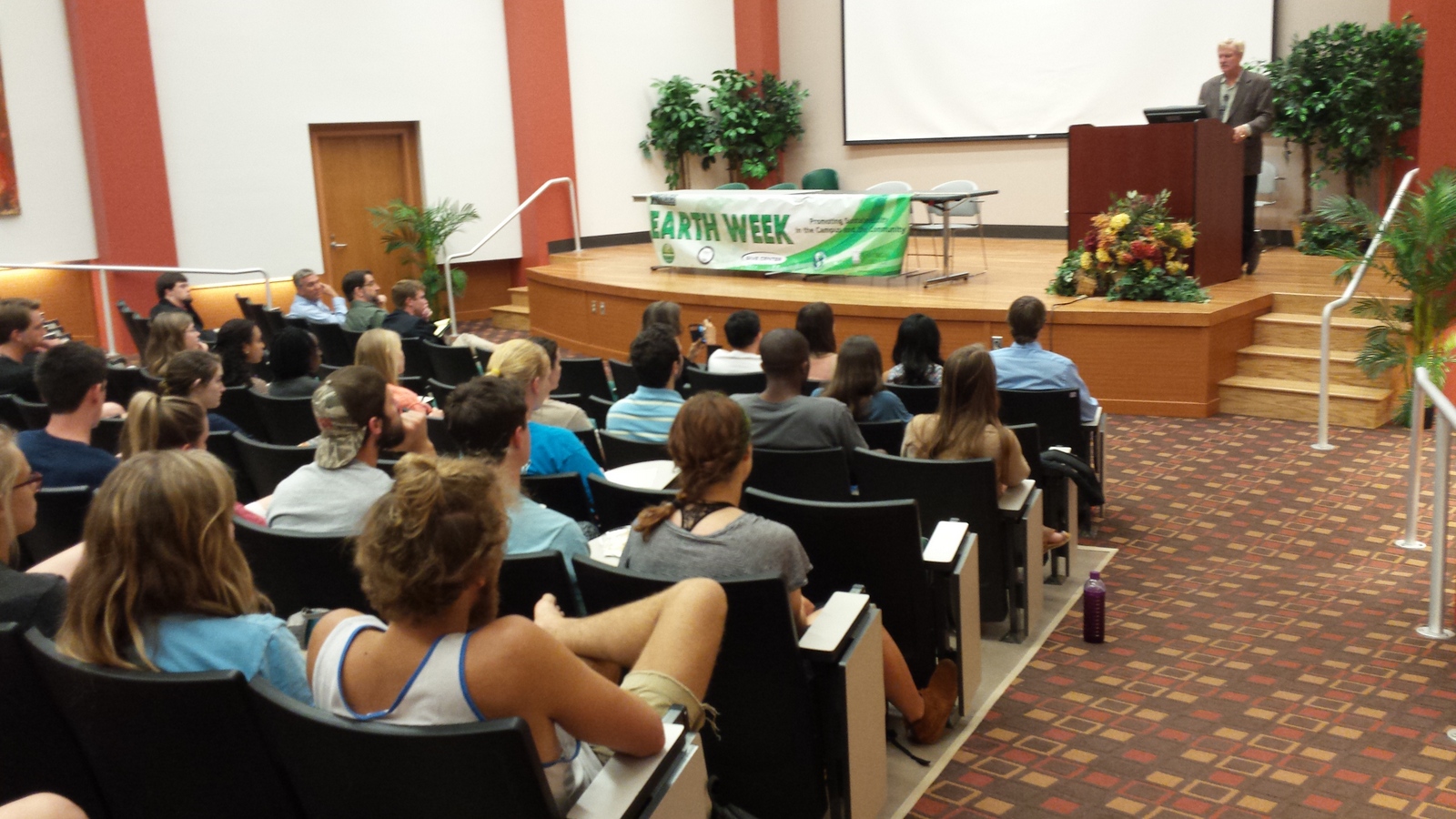
The Campus Green Initiative Symposium on April 23, 2015 featured keynote speaker Gary Ferguson, an accomplished author and lecturer.  Mr. Ferguson delivered an engaging 45-minute lecture on how to get America back to the heyday of environmental appreciation.  The audience of over 100 was treated to a short history of the American environmental movement, and a call to action to recover the energy and commitment of the past and apply their lessons to today’s important issues.

Gary Ferguson at the 2015 Campus Green Initiative Fund Symposium.

Mr. Ferguson began revealing his legacy with the story of  Joe Knowles, a Bostonian dared by a local newspaper to spend two months alone in the Maine wilderness.  This event, while later stained by scandal, demonstrated that Americans have ‘sap in their veins.’  There was an explosion of nature writing and voyages into the wilderness to follow.  The environmental revolution of the 1960’s served to reveal human desires to live within nature and not poison our ‘Spaceship Earth.’  Mr. Ferguson delightfully articulated motivations to promote environmentalism from strictly economic terms to Joseph Campbell‘s vision of ‘humans healing through space.’

The pathway to an environmentally-inspired future lies in our ability to take small steps to create success.  Mr. Ferguson recommends achieving a ‘full ecology’ for all people, with dignity for humans and all species, built at the ‘ground level.’  He called on the audience to ‘be of your own hour’ and live for the protection of the natural world in three ways: 1) Find beauty and let it still you; 2) build community with self and nature; and 3) retain mystery as the source of all science and art.

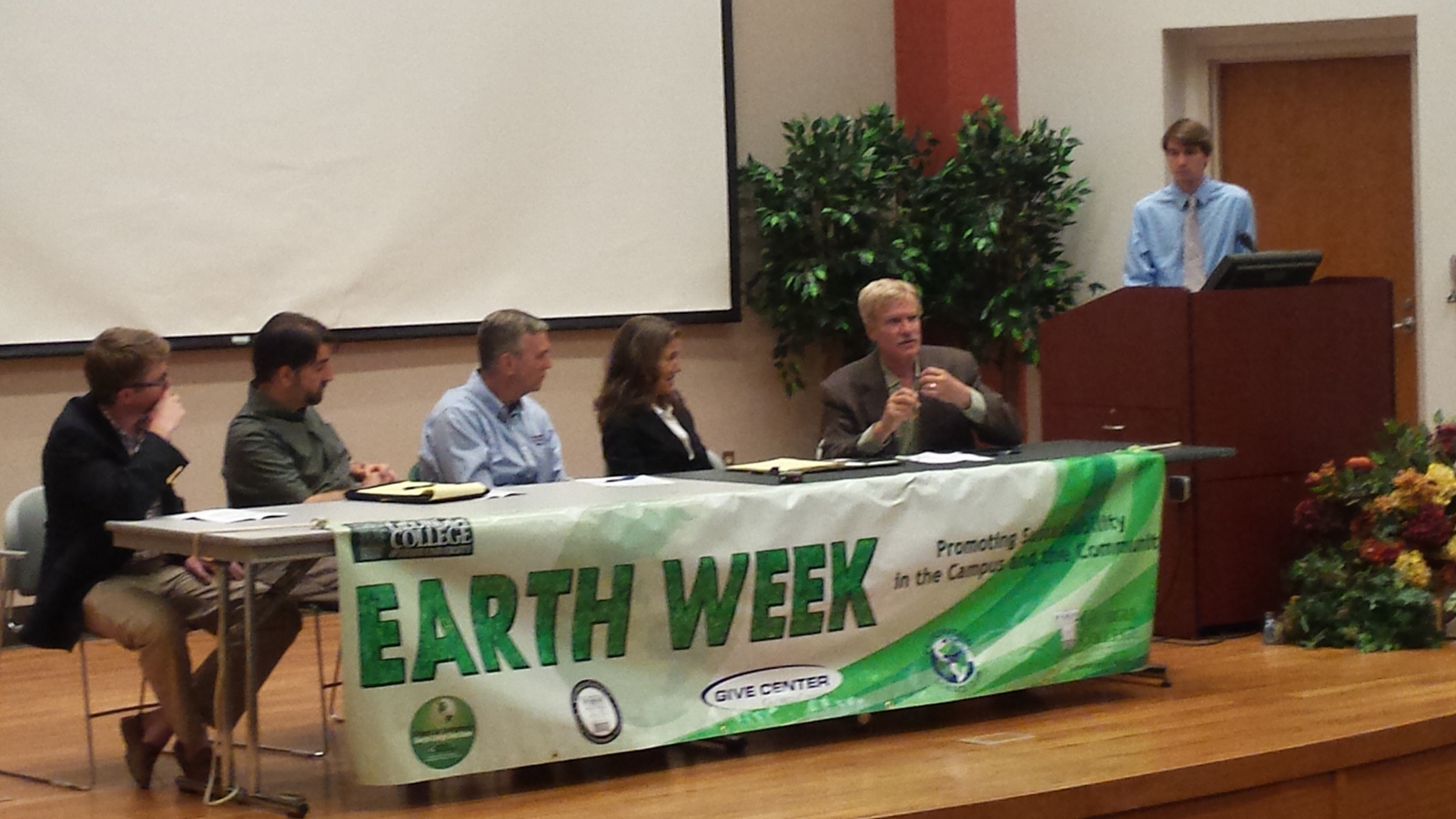
The keynote address was followed by a one hour question and answer session with Mr. Ferguson and a panel of noted scholars:

Panelists join Mr. Ferguson at the 2015 CGIF Symposium for a question and answer session on environmentalism in the current era.

Students were invited to ask questions of the speaker and panelists, including:

  • How can students get involved in protecting the natural world?
    • Find a passion in the outdoors, such as hunting or fishing.  Discover ways to reduce consumption of animal agriculture.  Think globally, act locally.  Imagine if everyone took good care of herself.  Listen to each other.
  • How can a small town ‘Act Locally?’
    • Work with the City Council and the local department of natural resources.  Engage local farmers.  Investigate options and plans, such as what to do with the abandoned Plant Branch coal facility.  Plant more native species and attract local pollinators.  Get local people fired up about clean water and air.
  • What are some tips for making a career out of environmentalism?
    • Learn how to talk with people, and how to relate to them.  Think critically and make good decisions.  Develop your argumentative skills in order to better persuade people.  Pay more attention to how to fix the problems and don’t dwell on what’s not working.  Learn how to force a paradigm switch.
  • How do we get over ‘the hump’ of building a sustainable society?
    • Avoid ‘soul death’ caused by too much ego illusion.  Learn how to be alone and enjoy the experience of failure.  Change starts one person at a time.  Be patient; it’s a never-ending battle.
  • Are Health Sciences related to Sustainability?
    • Yes, certainly.  Grief is related to one’s emotional ground.  There are links between the Earth, Air, Water, and Food to the human body.  Good food is good for the planet.

Physics Students Propose Energy and Water Improvements for Herty Hall

The April GreenBag Series discussion featured Physics majors Michael Crawford, Rhett Roberts, Parker McNair, Wenu Mutunda, Kyle Sorrells, and Jairus Elarbee.  As part of their senior research project, these students recently conducted an extensive study of enery and water use in Herty Hall.  Under the supervision of Dr. Hauke Busch, they examined heat loss through windows and doors, lighting (in)efficiencies, cooling systems, and potential water conservation designs.  The students came up with unique designs that could reduce carbon emissions and save hundreds of dollars per month.  Their presentation received a very encouraging reception from Mark Duclos, Director of Facilities Operations.

One of the more interested proposals was a method to capture condensate water from the roof of Herty and use it to irrigate plants in the public greenhouse adjacent to the building.  Over 15,000 gallons of water could be collected during the summer months, when irrigation is most needed.

The study also examined the potential benefits of installing revolving doors on the two front entrances to the building.  This small design improvement alone could cut heating and cooling expenses by $100/month.

For more information, please examine the Thermodynamics Presentation.

Narrow Ridge Earth Literacy Center

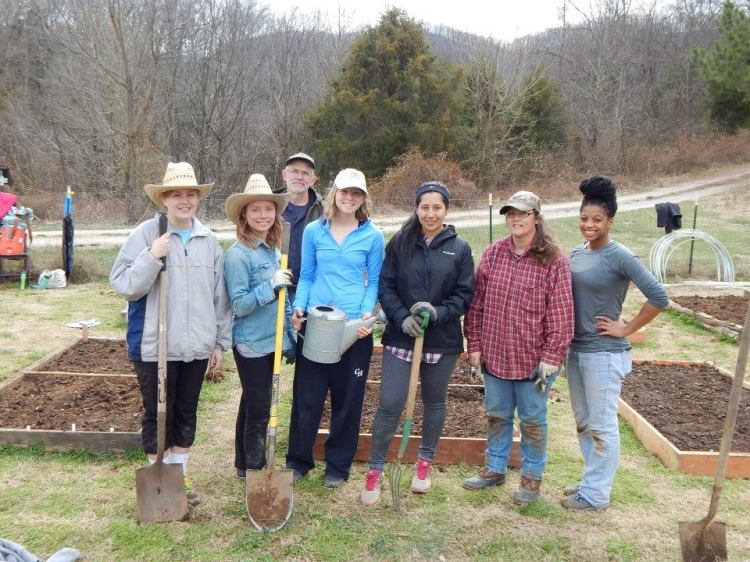
For Spring Break this year, Associate Director for Sustainability Lori Strawder accompanied three Georgia College students on an “Alternative Spring Break” to the Narrow Ridge Earth Literacy Center in Washburn, Tennessee.  The group learned about ways of living that don’t damage the Earth, including permaculture gardening, energy efficient housing, and low-water plumbing.

narrow_earth_literacy_center_1503
Georgia College faculty and students at the Narrow Ridge Earth Literacy Center for Alternative Spring Break 2015

“We built lodges of straw and used cellulose fiber to seal the cracks,” said Sara Loaiza, a senior in Mass Communications.  “The dwellings will last 100 years when they are tightly sealed, and are not a fire hazard.”

“All our energy came from solar panels, which get sun even in winter,” added Lauren Gorham, a freshman in Liberal Studies.  “I didn’t miss anything from being off-the-grid for a week.”

The facility uses composting toilets, that combine human waste with peat moss to produce a fertile supplement to gardens.  As much as possible, the center produces food to feed everyone on the property in every season.

At night, to conserve energy, the group used candles to work on jigsaw puzzles or keep the conversation alive.  The students brought home several ideas on how to incorporate sustainability in to life at Georgia College.

“We have a lot of good information to help us with the campus garden,” said Gorham.  “And we hope we can make improvements in conserving resources and adding an awareness to daily life.”

Composting at Georgia College

The March 2015 Green Bag Discussion was facilitated by Susan Daniels, Assistant Director for Landscaping and Grounds.  Susan led a discussion on the production and usage of organic materials at Georgia College, including the installation of a new industrial food waste composter and the school garden at West Campus.

Susan has been at Georgia College for over 25 years, and she recalled in 1994 when the school first began saving money and labor by incorporating grass clippings, leaves and straw, and soil amendment into a ‘cosmetic pine straw’ that was applied to landscaping beds.  The grounds crew would also apply their homemade compost to erosion scars, especially following major landscaping projects.  The materials were stored at a couple of sites at West Campus before moving up the hill to the Tower Site off of Hwy. 49.

IMG_8429
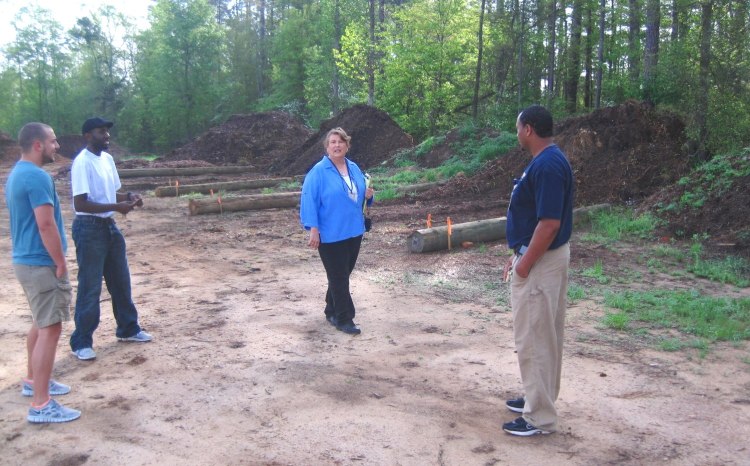
Assistant Director for Landscaping and Grounds Susan Daniels (center) conducting a tour of the campus composting facility at the Tower Site.

Susan is now investigating ‘active composting’ using vegetable scraps from the Sodexo dining hall.  She informed the discussion group of the difference in health code requirements between ‘pre-consumer’ and ‘post-consumer’ food scraps.  Once the food has had the opportunity to touch a human mouth, different, more stringent, requirements are in place, in order to get the temperature of the compost high enough to kill human pathogens.  The new composter, when installed, will be capable of achieving these requirements, but it will take some time to get it programmed correctly by adding the right amount of landscaping material to the composting mix.  Susan mentioned that the UGA Extension Service is hosting an industrial composting training session in Athens on March 19th and 20th.

The conversation turned from the production of compost to what to do with it.  Susan envisions a community involvement project, working with ENGAGE and other outreach entities.  Local school groups, citizens, and other state agencies could benefit from such a program.  Susan would like to connect composting to education, and let people walk away with a healthy addition to their own gardens.

“The way to get rid of erosion is to grow something, and the way to grow something is to improve the soil,” said Daniels.

An additional benefit of a school composting program will be the addition of nutrient-rich soil to the Campus Garden.  Susan would like to see the garden site support science-based investigations on how to improve soil, compost yard waste, and produce good food.  Dr. Sandra Godwin commented on the prospects of incorporating both the composting project and the campus garden into classes on ‘Food System Economics,’ ‘Agroecology,’ and ‘Food Ethics,’ all of which are currently offered at Georgia College.