You have probably heard of Arbor Day on many occasions, but have you ever stopped to think about the significance of this tradition or how we observe it on campus? The first official observance in the United States was held on April 10, 1872, in Nebraska; and it is now celebrated nationally on the last Friday in April. However, many states also hold their own observance to coincide with the prime planting dates in their regions, with Georgia holding its Arbor Day on the third Friday in February. Each Arbor Day presents an opportunity to reflect on and recognize the importance of maintaining healthy trees, which provide many benefits including food, oxygen, shade, energy conservation, soil erosion prevention, clean air and water, and many more.
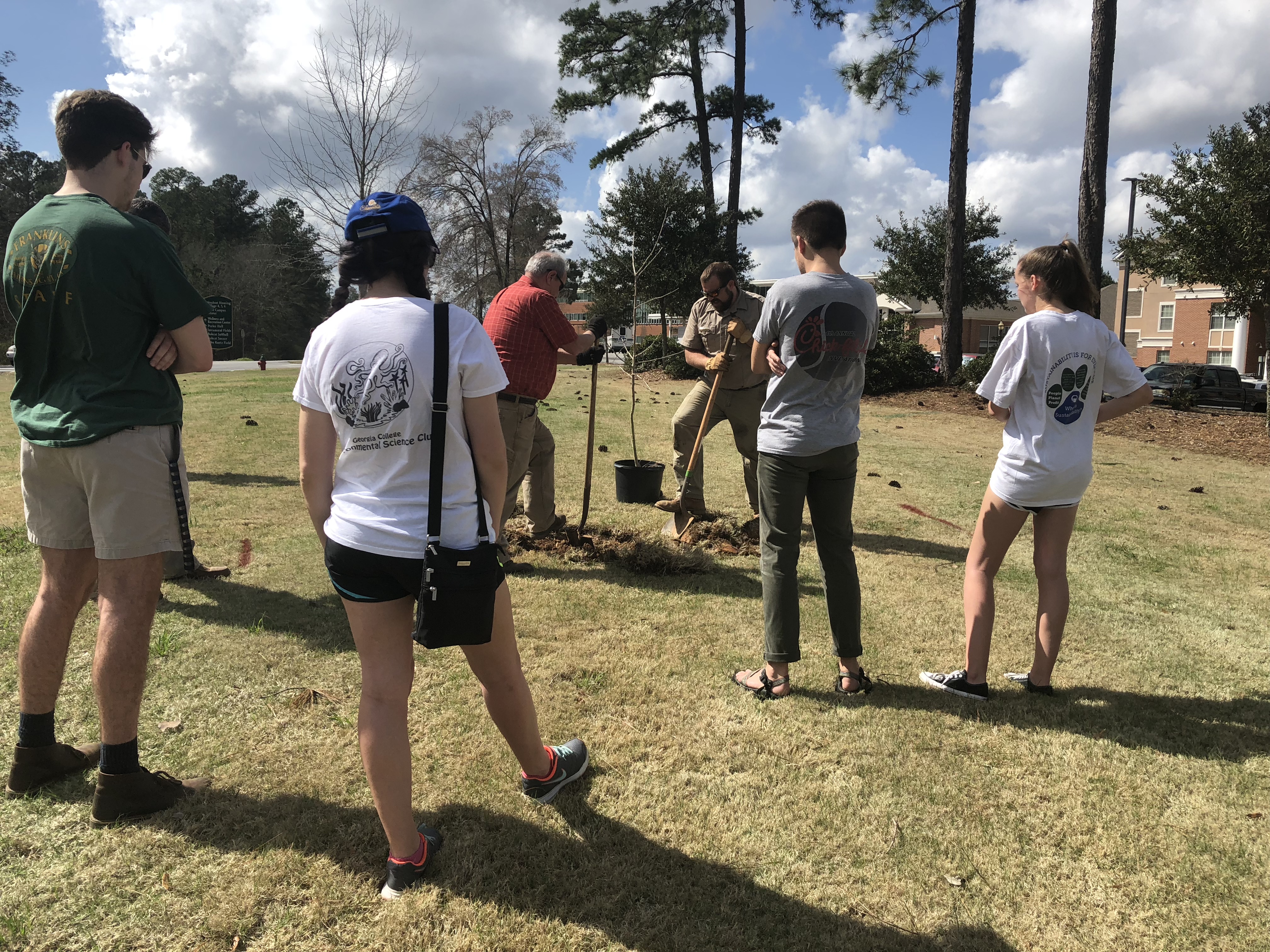
Here at Georgia College, the Grounds Department, the Office of Sustainability, and the Earth Action Team teamed up on February 23 to celebrate Georgia Arbor Day. Five ginkgo trees were planted along the West Campus Entrance. This species was chosen due to the spectacular yellow color that the trees showcase in the fall, which will create a dramatic drive and view from the village apartments. The staff and students who participated were treated to a special demonstration of correct tree planting techniques by Seth Hawkins, certified arborist, community forester, and member of our campus tree committee. By using those techniques, the participants helped to ensure the survival of the five trees. Mr. Hawkins also allowed us to video his explanations, and you can learn how to successfully plant trees by watching Part 1 and Part 2.
Our Georgia Arbor Day celebration not only allows us to reflect on our state tree holiday but also kick off our National Arbor Day celebration. Each year, individuals and organizations on campus are invited to volunteer to plant trees in the weeks leading up to National Arbor Day, which will be held on April 27. We are proud that Georgia College is a Tree Campus USA, and we hope that you will join us in maintaining our tree canopy. Email Aaron Seay, grounds supervisor, or Kristen Hitchcock, Sustainability Coordinator, to schedule your tree planting.
Starting February 4th, the 2018 RecycleMania campaign has begun! Based in Washington D.C., RecycleMania is an eight-week-long event dedicated to promoting recycling efforts in college campuses across the United States and Canada. As stated by the organization itself, “Using fair and friendly competition, RecycleMania provides tools and opportunities that inspire, empower, and mobilize colleges and universities to benchmark and improve efforts to reduce or eliminate waste.” RecycleMania serves as a vehicle for increasing recycling and sustainability efforts nationwide. Georgia College will compete alongside countless schools, including Georgia State University, Auburn University, and even Harvard University, to boost our recycling rates. The school that races to the top of the scoreboard will receive international recognition, an award made of recyclable materials, and the honor of hosting the organization’s traveling trophy for a year.
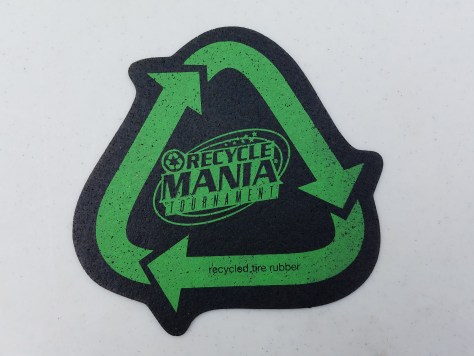
RecycleMania logo made from recycled tire rubber
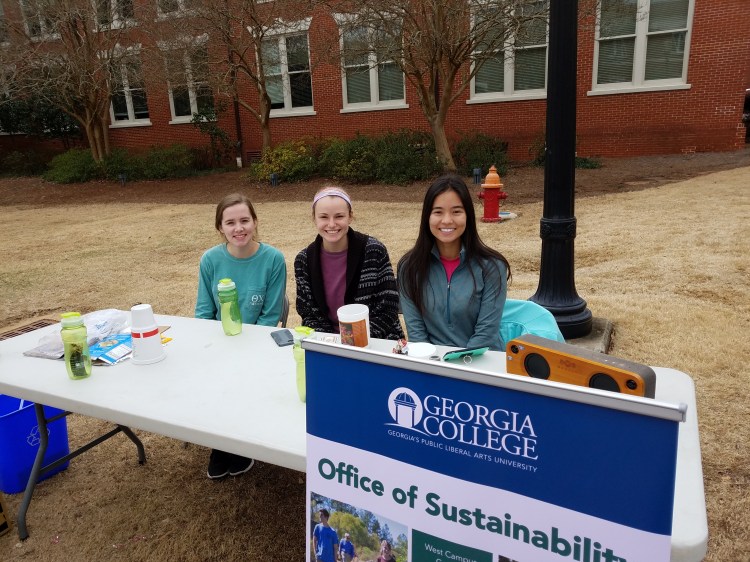
On February 9th, Georgia College officially kicked off its participation in RecycleMania. Interns from the Office of Sustainability tabled outside of the Arts and Sciences building and provided pertinent recycling information in regards to what can and cannot be recycled at Georgia College, as well as a small game to discern what the campus can recycle. Participants in the game received a free water bottle. This is the first of many more recycling and RecycleMania based events to occur in the upcoming weeks.
Office of Sustainability interns help kick off RecycleMania at Georgia College.
RecycleMania rates schools based off of three categories: total recycling per capita, smallest waste generation, and highest rates of recycling as a percentage of total generated waste. Scores are updated weekly and schools are ranked accordingly. Last year, Georgia College achieved recycling rates of 6-8%; and our goal this year is to surpass those percentages. Throughout this competition, the Office of Sustainability will be hosting a multitude of events in order to promote the campaign and raise our scores. Recycling is one of the Office of Sustainability’s chief sustainability programs, and we hope that RecycleMania increases the education of and participation in the recycling initiative.
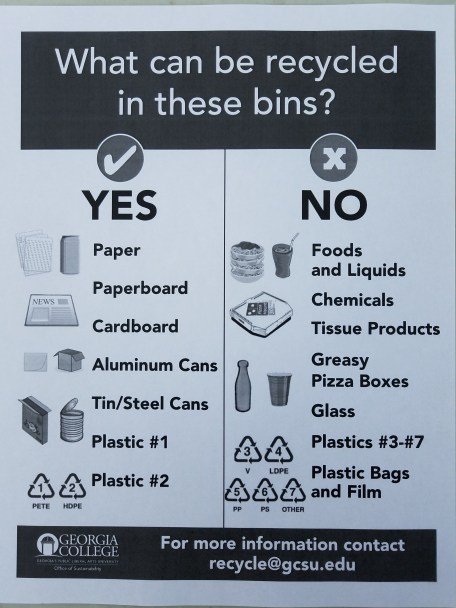
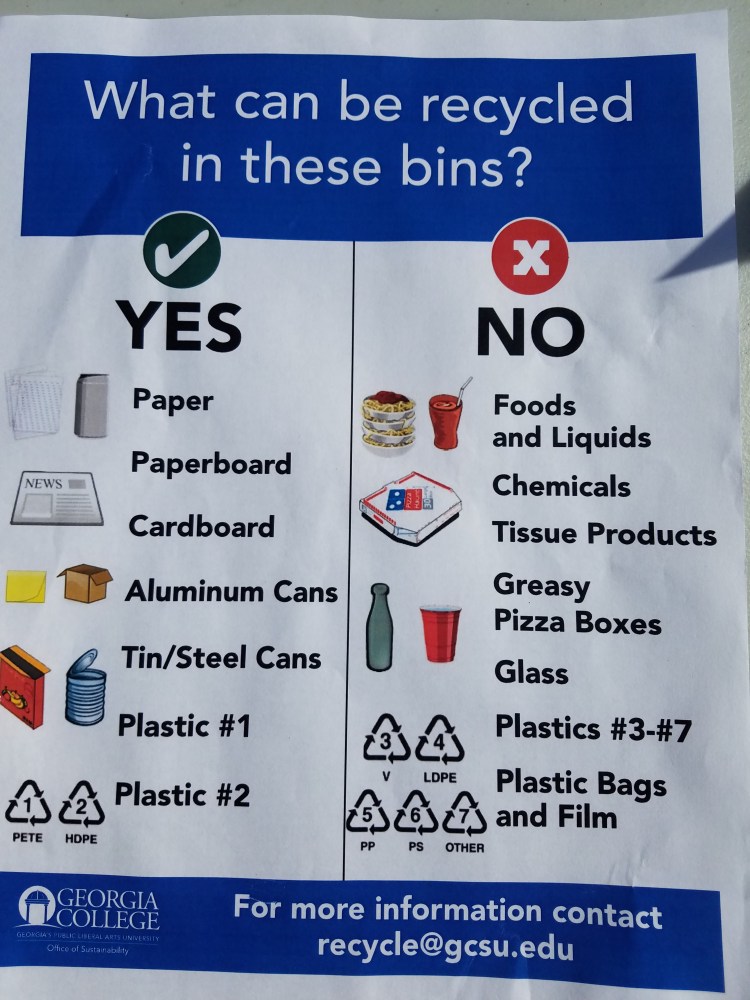
Informational poster of what can and cannot by recycled at Georgia College
Georgia College supports recycling of paper, cardboard, paperboard, and plastics #1 and #2 (Plastic products have a small number inside of a recycling symbol on the surface of the object). We encourage all students and staff to take part in this exciting event and help rocket Georgia College to the top of the scoreboard!
As the new year begins, the Office of Sustainability encourages you to consider a sustainable New Year’s Resolution for 2018! Check out our previousblog postif you’re in need of some ideas! We also found some students on campus that have their own eco-friendly resolutions.
Our very own intern, Elizabeth, has resolved to stop using plastic straws for the new year. Instead, she carries stainless steel, reusable straws with her!
Another one of our interns, Ryan, has decided to stop using plastic bags. Instead, he brings his own reusable bags to the grocery store!
Our compost intern, Jake, aims to educate 200 people on sustainability and environmental practices in 2018!
Ashlie, a zero-waste advocate and intern, has given up bottled shampoo for 2018. Instead, she will be using Shampoo Bars from LUSH, which are packaging-free and last for over 80 washes!
Let us know if you’ve committed to a sustainable resolution, no matter how small! We will keep you updated on how well our interns stick to their resolutions!
It’s hard to believe that we are already 8 days into the new year. By now, you may have already set a few resolutions for 2018. If you already have goals in hand, or if you are looking for some resolution inspiration, we have a few suggestions for ways you can live more sustainably in 2018.
Skip the Straw. According to the 5 Gyres Institute, “plastic straws are one of the top polluters on our beaches.” You can help by stopping your use of plastic straws this year. Instead, carry a reusable or biodegrable straw with you.
Ban the Bag. Another simple way to help reduce plastic pollution is by refusing plastic bags. Commit to carrying reusable shopping bags each time you visit a store in 2018 so that you can leave those plastic bags behind.
Try Meatless Monday. You may have seen the #meatfreemonday or #meatlessmonday movement on social media. According to the team at Meatless Monday, there are multiple human and environmental health benefits of eating less meat, including minimizing your cancer risk and reducing greenhouse gas emissions. You don’t have to adapt to a full vegan lifestyle, however. Why not resolve to eliminate meat on just one day a week – Monday – during 2018?
Carry a (Reusable) Cup. Although the percentage varies by factors such as age and gender, the average adult body is comprised of 60% water, which means staying hydrated during the day is vital to your health. Some of us also need a little caffeine boost in the morning. Before you head out for the day during 2018, be sure to grab a reusable bottle so that you don’t add disposal cups and plastic bottles to the landfill. There are even some collapsible options out there, like the Stojo, which may be easier to carry with that reusable straw and bag!
Kill-A-Watt. During 2018, you can not only reduce your environmental footprint but also save money on your energy bill by resolving to use less electricity. Next time a bulb burns out, replace it with a more energy efficient LED bulb. If you have to replace any appliances this year, make sure to buy Energy Star rated models. Each day walk through your residence and unplug any electronics that aren’t in use, because they pull “vampire wattages” from the grid even when turned off.
These are just a few, simple resolutions you can adopt to reduce your environmental footprint in 2018. Pick your favorite and try it out. Even small changes, which are easier to stick to, can make a big impact.
Kristen Hitchcock is the Sustainability Coordinator for Georgia College’s Office of Sustainability and has been since August 1, 2016. Hailing from Tennille, Georgia, Ms. Hitchcock was raised on her grandfather’s farm. She spent her childhood exploring the woodlands near her house, which helped to inspire within her a love of nature. Ms. Hitchcock would go on to earn an undergraduate degree in Applied Biology from Georgia Tech and eventually a Masters in Environmental Management from Duke University. Afterwards, Ms. Hitchcock moved to Pittsburgh, Pennsylvania, to work as an environmental consultant for eight years. However, she would ultimately desire to move back closer to home and pursue a sustainability-related job, which was when her current position opened up at Georgia College. She feels very fortunate to be working so close to home, and many of her relatives, in her desired field. In her free time, Ms. Hitchcock enjoys outdoor-related activities, such as hiking and camping, as well as reading, music, and singing.
Upon beginning her work with the Office of Sustainability, Ms. Hitchcock details how “one of the first things that I did was to increase our social media and educational outreach on campus, and I plan to continue and improve upon these efforts.” Ms. Hitchcock believes that continual sustainability education is paramount to build a “culture of sustainability” here on campus. She describes how “the job of a sustainability coordinator is to eventually put yourself out of a job because you are working towards making sustainability an effortless, normal part of your organization’s operations.” She strives to integrate sustainability into the campus in order to facilitate a more accessible, sustainable lifestyle. Furthermore, Ms. Hitchcock endeavours to improve data analysis on campus; she feels that a more accurate/efficient database of resource use is essential to improving our performance in regards to resource usage.
Additionally, Ms. Hitchcock describes how she hopes to help “embed sustainability further into the culture of [the] campus, such that it becomes second nature for out students, staff and faculty to do things like reduce their waste, recycle, turn off lights, use bikes on campus, walk around town, and any number of easy, sustainable living practices.” She hopes to increase the visibility and influence of the Office of Sustainability so that sustainability culture may continue to develop. Ms. Hitchcock has already seen large growth in the Office of Sustainability during her time here; she states, “When I first started, students saw our table and didn’t know that we have an Office of Sustainability. Now, when I set up our table at events, I have students seek it out and start asking about internship opportunities or ideas they have for our campus. It has been really rewarding to know that I have been a part of this tremendous growth in such a short time.”
Currently, there are a few major sustainability initiatives on campus. Ms. Hitchcock explains how the recycling program is “[o]ur biggest and most forward facing sustainability effort on campus.” Other efforts include the West Campus Garden, maintaining Georgia College’s Tree Campus USA certification, and the composting initiative. The compost initiative, especially, has flourished throughout this semester, and in a rather short amount of time, as Ms. Hitchcock states, “we have increased the amount of food waste that we collect, as well as general awareness about our compost project.” The campus recently received a grant to go towards the implementation of a Campus Kitchens program at Georgia College. Ms. Hitchcock hopes to use the Campus Kitchens program in congruence with the composting initiative in order to aid those who are food insecure in the community. She believes that the composting project and Campus Kitchens program “can be used to not only alleviate these problems [food insecurity and food waste] in our community but also teach our staff and students more about these two very important issues.”
When asked what the term “sustainability” means to her, Ms. Hitchcock responded, “I use the definition of sustainability that has been adapted from the Brundtland report, which is ‘meeting the needs of the present without compromising the ability of future generations to meet their needs.’ However, my personal caveat to this definition is that we really need to question what our needs truly are…at our current rate of consumption, we risk exceeding the carrying capacity of Earth.” Naturally, Ms. Hitchcock is extremely passionate about sustainability, but as she states, “not only am I passionate; I am also determined. Determined to ensure that Georgia College implements sound sustainability practices.” Ms. Hitchcock enjoys the dynamic nature of her job, as each new project requires a unique approach maintained with constant attention and analysis, and how ”[t]here is always something new to learn about sustainability.” Her goals for sustainability on campus are partially hampered by the limited space and resources in the Office of Sustainability, but with a dedicated, passionate staff and a boundless tenacity, Ms. Hitchcock is committed to the growth of sustainability on campus for the betterment of our world.
Classes are ending soon, and the winter holiday season is kicking into gear. This time of year brings a lot of excitement, and bit of the stress as we try to juggle travel, parties, and gift exchanges. With everything going on, it can also be easy to overlook the environmental impact of these activities. However, there are a few simple ways that you still practice sustainability during your holidays.
Send e-cards. Cards are often the first item on the to-do list for the holidays. After you have your holiday greeting list together, consider using electronic cards, instead of mailing paper ones. If you still love mailing out cards, buy ones that are printed on recycled paper or that have recycling reminder on them. You might even consider buying fair trade, handmade cards, such as those sold at Ten Thousand Villages.
Give ethically sourced gifts. Speaking of Ten Thousand Villages, they and other merchants have options for fair trade and ethically sourced gifts.
Buy local. You can also consider supporting small local businesses or artists. It takes a lot of energy and fuel to ship goods long distances around the holidays. When you buy local, you can help reduce these emissions while also supporting your local economy…and surprise your friends with unique gifts.
Choose green wrapping. Once you have chosen your gifts, consider your wrapping carefully. Some wrapping paper cannot be recycled, due to the presence of components like foil or glitter. Check with your local municipality or recycling station and ask what types of wrapping paper are accepted in the waste stream and choose carefully. You can also let your creativity shine! Reuse materials such as newspaper. Put your gifts into reusable shopping bags. Take your worn-out clothing or towels, cut them, and tie them around packages; and here is a Craftsy link to get you started.
Use less energy. The holiday decorations are a literal bright spot to the season, and sure to bring happiness to you and your neighbors. However, don’t let them lead to the post-holiday, high-utility bill blues. Use LED lights, which are more energy efficient, and time your lights carefully so that they aren’t burning 24/7. In addition to those two tips, the Department of Energy also suggests searching for rebates and using reflective decor.
Say no to single use party supplies. If possible, try to supply your party guests with reusable dinnerware to avoid creating large amounts of plastic waste. If you are anticipating having a lot of leftovers, and don’t want to waste the food, encourage your guests to bring their tupperware so that they can take them home.
Practice self care. The triple bottom line of sustainability is PEOPLE, planet, and profit. With so much to-do this season, don’t forget to take care of yourself. Get plenty of rest. Go to a local park, because time in nature has been shown to reduce stress levels.
We want to wish everyone a happy holiday season and remind you to have fun and travel safely. These are just a few tips to help you “green” your celebrations. What are some of your ideas? Share them with us below.
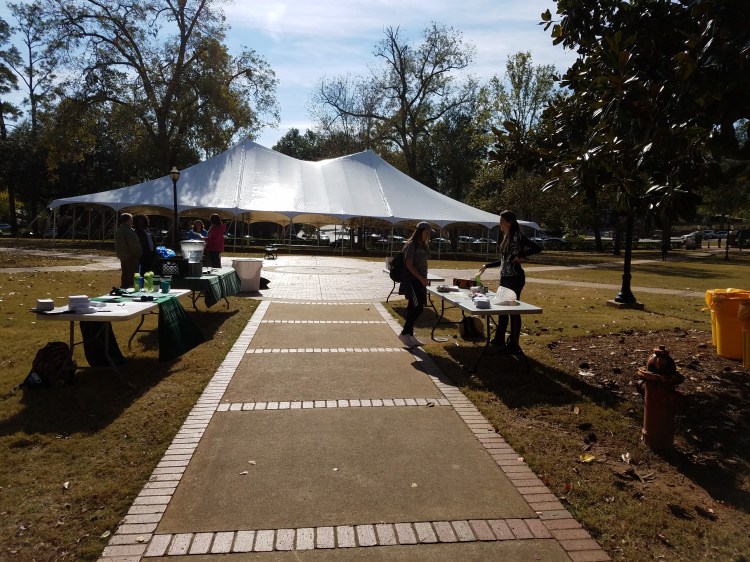
Front View of America Recycles Day at Georgia College.
On November 15th, The Office of Sustainability hosted its America Recycles Day event. America Recycles Day is a national initiative by the Keep America Beautiful organization focused around encouraging and inspiring people all over the nation to recycle effectively and help preserve the environment. The event was held at Georgia College in conjunction with Ethics Awareness Week, where students and faculty were encouraged to bring outdated important documents to shred. Not only did this encourage participants to practice safe handling of their information, but the shredded paper was also used to facilitate the development of food waste into compost here at Georgia College. To conclude the event, Office of Sustainability intern Ashlie Adamson offered a talk on a myriad of products designed to enable zero-waste living and the difference that zero-waste living can make in our community.
One of the largest sustainability initiatives at Georgia College is the recycling program. Representatives of the Office of Sustainability served to educate students and faculty about what can and cannot be recycled on the campus. Recyclable items include paper, cardboard, and aluminum and steel cans, as well as plastics #1 and #2. Additionally, the event served to inform the campus about the benefits of recycling for the economy and the environment. Georgia has one of the largest markets for recyclable materials in the nation; roughly one-third of all plastic beverage containers that are recycled in North America end up recycled in Georgia, and over 120 business in Georgia use recycled materials to manufacture new goods, according to the Georgia Recycling Coalition. Novelis, one of the world’s largest aluminum recycling companies, has its headquarters in Atlanta. The event also described the impact of individual people recycling; recycling a single plastic soda bottle will save enough energy to power a T.V. for 1.5 hours, while recycling one glass bottle saves enough energy to power a 100-watt light bulb for four hours.
A guide to what can and cannot be recycled at Georgia College.
In addition, the event informed attendees of the benefits of composting. Composting has the potential to save money by reducing the need for fertilizers and mulch, as well as enriching the soil. The organic matter found in compost increases the soil’s ability to retain water, allowing people the ability to save money on their water bills. Composting also helps stabilize soil in areas prone to erosion, increasing plant growth and soil cover. Furthermore, composting helps reduce the total waste found in landfills. Compostable materials account for more than 30% of all waste thrown away within a year. The decision to compost can greatly increase the lifespan of landfills all throughout the nation and the world. Moreover, there are currently 34 official composting operations recognized in Georgia by the Environmental Protection Division of the Georgia Department of Natural Resources and commercial composters provide roughly four times as many jobs as landfilling these materials creates, according to the Unified Government of Athens-Clarke County. Meanwhile, Georgia College is continuing its composting initiative, which takes post-consumer food waste from the MAX and converts it into usable compost. Some of this compost is used for the Community Garden on West Campus.
Georgia College’s America Recycles Day event saw support from the following clubs/organizations: the Environmental Science Club (gcenviroclub@gmail.com), the Office of Sustainability (sustaingc@gcsu.edu), the Earth Action Team (cameron.skinner@bobcats.gcsu.edu), and the Gardening Club (savannah.harrell@bobcats.gcsu.edu). Through this event, Georgia College hopes to educate students and faculty on the benefits of recycling and composting and to urge us all to participate in these initiatives through the college and in our own lives to help sustain our planet.
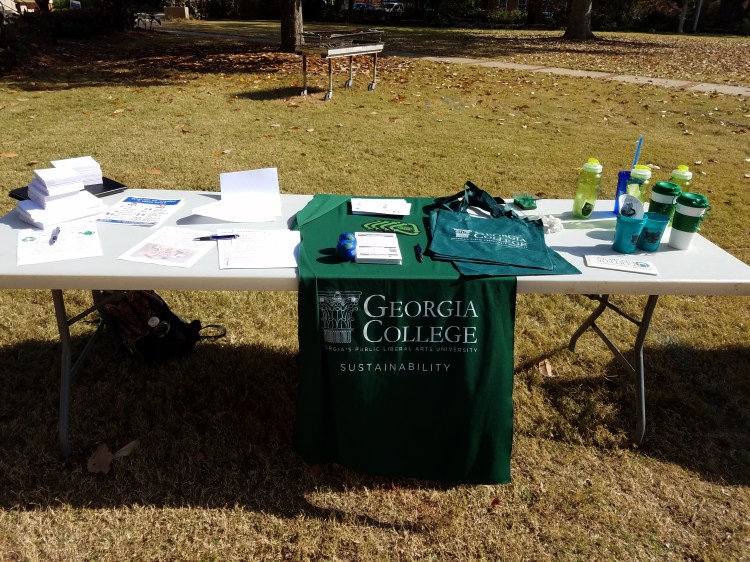
The Office of Sustainability presents various information about and opportunities to recycle at Georgia College.
Cameron Skinner is a junior environmental science major here at Georgia College (GC) with a minor in geology. He was born in raised in Dublin, Georgia. He has played tennis for seven years but now focuses mostly on academics, work, and community service. He has a younger sister who is ten years old; and, in addition to working at the Office of Sustainability, Cameron serves and bartends at Ruby Tuesdays.
Cameron Skinner has worked in the Office of Sustainability for five months as one of the Materials Recovery interns. One of his main goals in his position is to “gear [Georgia College] towards more zero-waste initiatives and to improve our recycling plan.” He also hopes to increase the outreach of the Office of Sustainability and inspire other students to aid in the continuous efforts to preserve the environment. Over the three years that Cameron has attended GC, he has witnessed the Office of Sustainability develop from a single permanent staff member to two permanent workers aided by thirteen interns. He bears witness to the ever-growing network of faculty and students dedicating their time and talent to sustainability efforts.
Cameron is very passionate about sustainability as he believes that it is “the only option for humanity to prosper in the future.” To him, the term “sustainability” is “a philosophy that recognizes the importance and urgency of altering the way people utilize their resources.” He is not the only one who holds these sentiments over sustainability efforts; Cameron describes his colleagues as “very driven and passionate about sustainability on campus.” He describes how the Office of Sustainability has attracted a myriad of majors to participate in their efforts, from environmental science majors to psychology, economics, and marketing majors. Over the next few years, Cameron would like to see the Office of Sustainability continue to grow in size and influence. Cameron would also like to see the department move to a larger office space in order to be more visible and present throughout the college.
Some of the largest and latest sustainability projects on campus, as described by Cameron, are the installation of solar panels on top of Herty Hall and the composting initiative. He describes, “The Herty solar panels were the result of two physics students who drafted a proposal and submitted it to the Sustainability Fee Council (SFC) where it was approved for funding.” The project is designed to minimize the total energy consumption of the building and hopefully others in the future. Meanwhile, the composting initiative has been reusing post-consumer food waste from the MAX all semester long and has been providing compost for the GC garden. Cameron is also working with a colleague, Julia Steele, to organize a Campus Kitchen at GCSU. This would work towards helping those who are food-insecure by providing them with leftover food from the MAX. The team has recently received a $5,000 launch grant towards the project from an online video competition.
Cameron finds it challenging to devise ways in which “hard-to-recycle items” can be removed from landfills and reused, as well as educate the campus on what can and cannot be recycled at GC. He enjoys working alongside faculty and students to help maintain the environment, as well as “[decreasing] our anthropogenic footprint.” Cameron encourages students and faculty to visit www.gcsu.edu/green to learn about the efforts of the Office of Sustainability and how they can become involved. In addition, students can submit grant proposals which are reviewed by the Sustainability Fee Council. More information can be found by emailing green@gcsu.edu.
Front View of Georgia College’s Campus Sustainability and Food Day
On October 24th, Georgia College hosted its annual Campus Sustainability and Food Day. Held in congruence with National Food Day and AASHE’s (Association for the Advancement of Sustainability in Higher Education) Campus Sustainability Month, this event sought to promote the sustainability efforts of local businesses and campus organizations, as well as local farmers and agriculture. Participants in the event included the Office of Sustainability, Salamander Springs, Comfort Farms, the Oconee River Greenway, the local wastewater treatment plant, the Earth Action Team, the Environmental and Gardening Clubs, and Non-Human Animal Rights advocates. Local restaurant Kirk’s Jerk Kitchen provided food samples. In addition, the campus presented John Wathen, a Hurricane Creekkeeper and environmental activist, who discussed the environmental impacts of several business practices in our region.
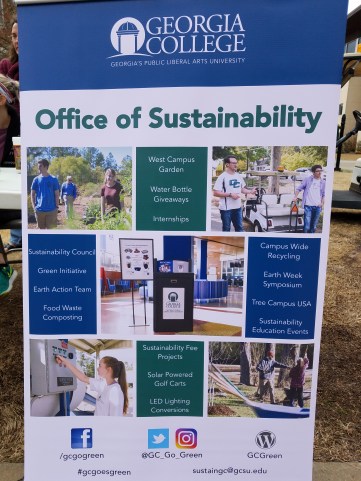
At the forefront of the on-campus efforts was the Office of Sustainability. The Office operates and oversees the major green efforts on Georgia College, including recycling and tracking the use of resources such as water and electricity. In addition, representatives from the Georgia College Sustainability Council were on hand at the event. The council is dedicated to reviewing and implementing initiatives on campus to promote sustainability. The major program of the council is the “Green Initiative,” which serves to incorporate and disseminate principles of environmental protection to the university and the surrounding community.
Additionally, the new Earth Action Team engaged in the event. The Earth Action Team functions through the GIVE center on campus and allows students to take a hands-on role in the upkeep of our ecosystems. The Earth Action Team is working with the composting project on campus, which takes post-consumer food waste from the Max Dining Hall and transforms it into usable compost. The environmental science-based organization is also now working to partner with the Campus Kitchens initiative, which is a national organization devoted to hunger-relief efforts. The team is constantly looking for new volunteers who don’t mind getting their hands dirty in order to preserve the integrity of our environment.
Along with the other on-campus organization, the Gardening Club showed its support in this event. The Gardening Club grows organic produce, such as basil, grapes, peppers, and tomatoes. The club manages efficiency in its multiple plots by placing cardboard underneath the mulch in the garden in order to help retain soil moisture as well as suppress the growth of weeds. Recently, the organization has taken over management of the West Campus Garden; and the club is beginning to utilize compost from the campus compost project, despite the project still being in its infancy.
Salamander Springs arrived at the event to showcase what it calls “sustainability at its finest.” The farmhouse is just outside of Milledgeville and is a fully off-grid, self-sustaining homestead. It uses mainly solar energy to power its utilities as well as self-composting toilets, and the entire homestead is constructed out of recyclable materials. The farmhouse is committed to the growth of organic crops and produce, such as vegetables, culinary herbs, and medicinal herbs. The homestead offers its produce for sale frequently at the Mulberry Street Market in Macon and the Greenway Farmer’s Market in Milledgeville.
Ms. Meagan discusses the intricacies of Salamander Springs.
Furthermore, the campus saw advocates for Non-Human Animal Rights. These activists showcased their sustainability efforts in the form of recyclable containers as well as ongoing endeavors to help preserve endangered species.
Advocates for Non-Human Animal Rights display their dedication to sustainability.
Comfort Farms attended the event as well. Comfort Farms in Milledgeville is an agricultural therapy farm to help veterans afflicted with PTSD. The farm allows veterans to raise crops and animals in order to empower veterans and enable them to lead stable and successful lives. The farm grants veterans short-term accommodations, and works to enable participants to prepare for everyday life and a successful future through sustainable agriculture.
Furthermore, The Oconee River Greenway displayed its dedication to a sustainable future at the event. The Greenway Park and Riverwalk offers residents of Milledgeville and Baldwin County with a beautiful area to experience the outdoors. Filled with the soothing sounds of the Oconee River, the Greenway is a place to walk, bike, run, and relax in the full immersion of nature. In addition to the walking areas, the Greenway offers a multitude of stations for fishing, canoeing, and kayaking. The Greenway is ultimately dedicated to the full preservation of the Oconee River for future generations.
Local Restaurant Kirk’s Jerk Kitchen provided food for the event. Owned by a Jamaican family, Kirk’s Jerk Kitchen provides Milledgeville with the taste of authentic Jamaican Cuisine. Opened just last year, the family-owned business provides a wide variety of Jamaican and southern dining choices and can be found right along North Wayne Street.
Finally, the event held a representative from the local wastewater plant. The plant participated in the event to raise awareness for waste improperly disposed of through household and corporate water drains. These items included grease, garbage, rags, and even tires. The company also works with restaurants in order to help ensure that waste is being disposed of properly. The plant informed attendees about how the improper disposal of waste through the sewer system not only has environmental ramifications, but is also much more expensive for the plant to clean out as well as for people to have their drains cleaned and repaired from abuse.
Beyond the organizations that participated in the Campus Sustainability and Food Day, the college held a talk from John Wathen to discuss the environmental issues that he has observed in his time as an activist and photojournalist. Wathen began his career by working in the coal industry, and the constant exposure to the harmful elements involved in the job has permanently affected his health, one of these elements being coal ash. Wathen explored the extreme environmental consequences of coal ash and the mismanagement of the toxin. He explored how large amounts had entered into the Emory River on account of the unwillingness of corporations to dispose of the substance properly. This, in turn, contaminated the river and decimated the aquatic wildlife. Wathen urged listeners to stand up to these kinds of environmental injustices and work to hold firms accountable for their actions.
The Campus Sustainability and Food Day allowed Georgia College students a chance to interact with organizations devoted to sustainability efforts, as well as encouraging them to take part in the efforts to keep our world green.
An inside view of Campus Sustainability and Food Day.



 Georgia College Green Initiative